Nursing Scores Big in FY 2026 Appropriations 


The American Nurses Association (ANA) scored several legislative wins with the enactment of the latest funding package.  

On February 3, President Donald Trump signed the Consolidated Appropriations Act, 2026 (Public Law No. 119-75) into law to end the partial government shutdown.

This $1.2 trillion package funds most of the federal government, including the U.S. Department of Health and Human Services, through September 30, 2026. The measure separately provides a continuing resolution that funds the U.S. Department of Homeland Security (DHS) for two weeks to give lawmakers extra time to negotiate a longer-term DHS bill.  
The law provides funding for or extends several healthcare programs that are critical to nurses and the patients they serve: 

  • Title VIII Nursing Workforce Development Programs
  • National Institute of Nursing Research (NINR) 
  • Telehealth flexibilities 
  • Dr. Lorna Breen Health Care Provider Protection Reauthorization Act 
  • PREEMIE Reauthorization Act 
  • Preventing Maternal Deaths Reauthorization Act 
  • Medicaid 

Here is a glimpse of several legislative wins for ANA and the broader nursing community for fiscal year (FY) 2026 in this package: 

Continued Funding for Critical Nursing Programs and NINR 

Public Law No. 119-75 provides static funding – $305.472 million – to the Title VIII Nursing Workforce Development Programs in FY 2026. For those new nursing policy wonks, the Title VIII Programs are administered by the Health Resources and Services Administration and address all aspects of nursing workforce development, including education, practice, and retention.  

While static funding may not sound like progress, it was a HUGE win given that a previous version of the Labor-HHS-Education spending bill in the U.S. House of Representatives would have cut roughly $47 million from Title VIII by eliminating funding for the Nurse Faculty Loan Program and the Nursing Workforce Diversity Program. ANA and 64 additional organizations comprising the Nursing Community Coalition worked tirelessly to express the nursing community’s concerns with the proposed cuts.  Ultimately, the final measure provided level funding by simply reallocating $2 million from the Nursing Workforce Diversity Program to other programs within Title VIII.  

The law also provides $197.693 million for the National Institute of Nursing Research (NINR) and $19.5 million for the Substance Abuse and Mental Health Services Administration (SAHMSA) Minority Fellowship Program (MFP). Within the National Institutes of Health, NINR conducts and invests in nursing research and training. The SAMHSA MFP aims to improve behavioral health outcomes for all by providing professional development and training opportunities for nurses and other healthcare professionals who comprise the behavioral health workforce. ANA is a proud MFP grantee organization. The static funding that NINR and the MFP received is a huge feat for ANA and its coalition allies given that the President’s FY2026 budget called for the elimination of NINR and reorganization of SAMHSA into the proposed Administration for a Health America (AHA).

Extension of COVID Era Telehealth Flexibilities 

Public Law No. 119-75 extends telehealth flexibilities that were first put into place during the COVID-19 public health emergency through December 31, 2027. This extension prevents a sudden return to pre-pandemic requirements and ensures patients’ access to healthcare services through telehealth. Specifically, these flexibilities allow beneficiaries to receive virtual care from their homes without geographic limits, let a broad array of clinicians furnish telehealth services, and continue coverage for audio-only visits and other remote care modalities that increase access to care.

Reauthorization of Critical Programs that Support Provider Wellbeing 

The Dr. Lorna Breen Health Care Provider Protection Reauthorization Act (H.R. 929/S. 266) was enacted into law as part of the funding package. This measure reauthorizes, through FY2030, critical programs that aim to prevent suicide and reduce occupational burnout, mental health conditions, and substance disorders among nurses and other clinicians. Initiatives include evidence-based treatments, suicide and burnout prevention training, and national education and advocacy campaigns to improve awareness and reduce stigma around getting help. For the first time, grant eligibility will now be expanded to include entities focused on reducing administrative burdens on nurses and other clinicians.  

ANA was proud to advocate for reauthorization of these programs in collaboration with the Dr. Lorna Breen Heroes’ Foundation and other healthcare organizations through the All In Wellbeing First for Healthcare Coalition

Maternal & Child Health Funding and Reauthorizations 

Public Law No. 119-75 includes FY 2026 funding for several maternal and child health programs, including Healthy Start, the Maternal and Child Health Services Block Grant, newborn screenings, the Safe Motherhood Initiative, and the Maternal Mental Health Hotline.  

The package also reauthorizes critical maternal and infant health programs through the passage of the PREEMIE Reauthorization Act (S.1562/H.R. 1197) and the Preventing Maternal Deaths Reauthorization Act (S.2621)/H.R. 1909) through FY2030. These programs advance research, education, and interventions to reduce preterm birth, while bolstering federal support for maternal mortality review committees that help states better understand and prevent pregnancy-related deaths. ANA was proud to partner with 260+ partner organizations to advocate for the reauthorization of these programs. 

Medicaid Makes a Comeback 

Last year, ANA and its allies were crushed when Congress voted to overhaul the Medicaid program through the enactment of the One Big Beautiful Bill Act, despite our extensive advocacy efforts to defend the program. While the program is still slated to undergo significant changes that will impact patients’ access to care and the nursing workforce, the funding law enacts bipartisan measures that aim to improve access, coverage, and program administration. 

The Accelerating Kids’ Access to Care Act of 2025 (H.R. 1509/S. 752) requires states to establish a process through which qualifying out-of-state providers can temporarily treat children under Medicaid and the Children’s Health Insurance program without undergoing additional screening. The Ensuring Access to Medicaid Buy-In Programs Act (H.R. 1598) removes age restrictions on Medicaid eligibility for working adults with disabilities, allowing them to maintain coverage beyond age 65. The funding package also requires states to adopt clearer residency and coverage standards for military families. Finally, Public Law No. 119-75 directs the states and HHS to study the costs of maternity, labor, and delivery services to help inform Medicaid payment policies in the future.  
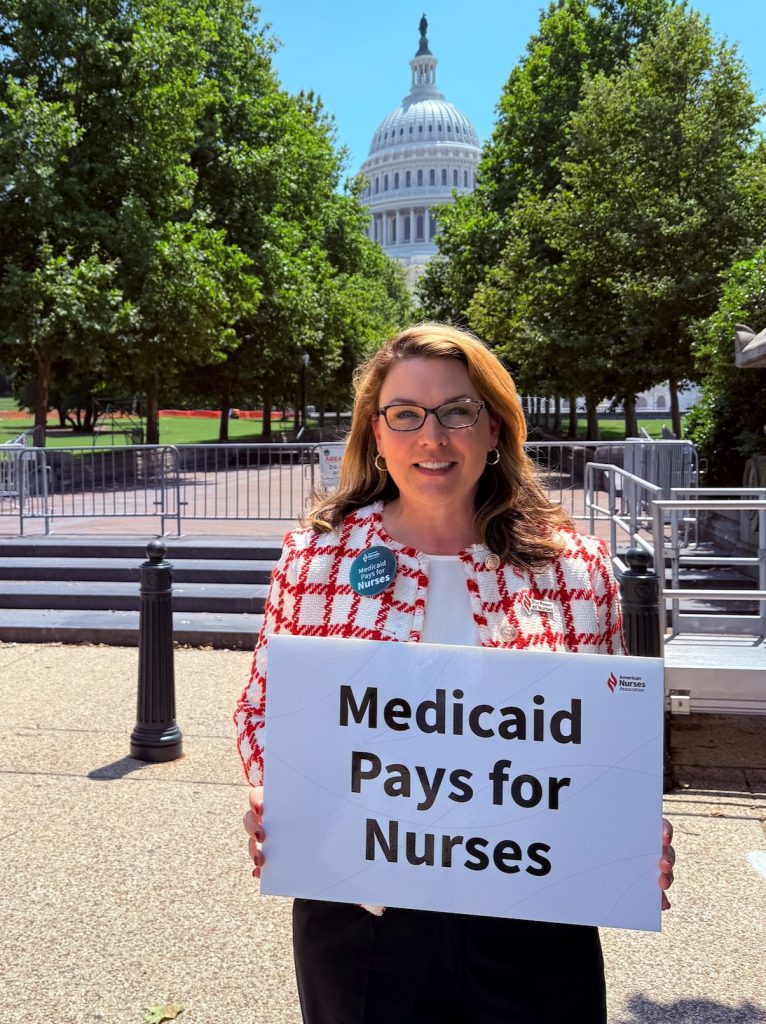
What Medicaid Reforms in H.R. 1 Mean for Nurses


As Americans were celebrating our nation’s birthday with BBQ and fireworks, President Donald Trump signed the One Big Beautiful Bill (OBBBA; H.R. 1) into law. This new law:

  • permanently extended the 2017 tax cuts,
  • adopted additional tax reforms, and
  • provided funding for other Trump Administration priorities.

One tax reform includes tax deductions on overtime pay for nurses, first responders, and others. To partially offset the law’s $3.3 trillion price tag, OBBBA includes almost $1 trillion in cuts to Medicaid spending and will make health insurance coverage inaccessible to 10 million individuals by 2034, according to estimates from the Congressional Budget Office.

Here is an overview of Medicaid and other health reforms that will impact the nursing workforce and the patients whom they serve.

Medicaid Finance Reforms

OBBBA makes several reforms that lower federal and state government spending on Medicaid and have a trickledown effect on healthcare facilities and the nursing workforce in these settings. For example, one provision restricts states’ use of provider taxes to finance their share of Medicaid spending with exceptions for nursing homes and intermediate care facilities. Another section in the bill related to state-directed payments changes how much states can direct Medicaid managed care plans to pay providers. Finally, OBBBA eliminates the temporary 5% increase to the traditional federal medical assistance percentage (FMAP) that the federal government provided to new expansion states under the American Rescue Plan.

Finally, OBBBA eliminates the temporary 5% increase to the traditional federal medical assistance percentage (FMAP) that the federal government provided to new expansion states under the American Rescue Plan.

Restrictions on Medicaid financing will force states to limit eligibility, coverage, and payments to meet statutory budget constraints.

Consequently, healthcare facilities that are heavily reliant on Medicaid funding will be forced to either cut critical services or close their doors altogether. This could:

  • jeopardize nursing jobs,
  • aggravate nursing workforce challenges, and
  • reduce reimbursement for advance practice registered nurses (APRNs).

Patients will ultimately see less access to care, particularly in rural and medically underserved communities.

Changes to Medicaid Eligibility and Access Policies

H.R. 1 also makes several policy changes that restrict Medicaid eligibility and access. Starting in 2027, the law requires adults between the ages of 19 and 64 to work or participate in a qualifying activity for at least 80 hours a month. Thanks to ANA’s advocacy, the law provides an exemption for adults who are enrolled in nursing school or other academic settings.

OBBBA will require states to conduct eligibility checks every six months beginning next year and restrict their ability to provide retroactive coverage starting in 2027. The law also delays implementation of the Eligibility and Enrollment Rule, a pair of Biden-era rules that aim to reduce barriers to enrollment in Medicaid and other programs, until 2035. One bright spot for patients in the law is its expansion of home and community-based services to individuals who do not need an institutional level of care beginning in July 2028.

Most of these policy changes will make it difficult for Medicaid beneficiaries to retain coverage and disincentivize other patients from enrolling in the program. Patients who no longer have access to Medicaid coverage will delay care and experience worse patient outcomes when they finally do receive care. Healthcare providers will also experience an increase in uncompensated care. While it is heartening to see H.R. 1 expand home and community-based services to patients who do not need an institutional level of care, the jury is out on whether these patients will have adequate access to nurses and other healthcare personnel.

Rural Health Transformation Program

H.R. 1 is projected to result in a $155 billion reduction in Medicaid spending in rural communities over the next decade, resulting in hospital closures and reduced access to care for rural patients. To blunt the impact on Rural America, the law establishes a Rural Health Transformation Program that will support efforts to address challenges facing rural health systems. Initiatives that aim to strengthen the rural health workforce, improve access to rural providers, and/or promote technology-driven solutions like robotics and artificial intelligence are perfect candidates for support from this program. OBBBA authorizes $50 billion in funding to the program with $25 billion equitably distributed among the states and $25 billion given out at the discretion of the CMS Administrator. More information from CMS is expected in September.

While well-intentioned, the reality is that this program does not fully offset the cuts that rural facilities will face because of the law. Additionally, the language in the section creating this program is written in a manner that makes non-rural facilities eligible for funding.

Delayed Implementation of Nursing Home Staffing Rule

Last year, the Centers for Medicare and Medicaid Services (CMS) finalized the Minimum Staffing Standards for Long-Term Care Facilities and Medicaid Institutional Payment Transparency Reporting Final Rule (CMS 3442-F). This rule:

  • sets minimum staffing standards,
  • requires a registered nurse (RN) to be onsite 24 hours a day, 7 days a week in long-term care facilities that participate in the Medicare and Medicaid programs, and
  • requires facilities to engage nurses in identifying staffing needs through facility assessments.

To help defray the cost of OBBBA, the law delays HHS from implementing the final rule through September 30, 2034. However, the facility assessment and Medicaid transparency provisions in the rule were excluded from the final text because they were subject to the Byrd Rule in the Senate. The Byrd Rule requires that provisions included in budget reconciliation measures focus on fiscal matters. This delay in implementation of the staffing rule only exacerbates staffing challenges in long-term care facilities that lead to nurse burnout and attrition from the profession. This moratorium also delays patient care and results in worse patient outcomes for nursing home residents.

Temporary Payment Increase for Healthcare Providers

Since Calendar Year (CY) 2000, the reimbursement rate that healthcare providers receive has been declining due to statutory budget neutrality requirements. This gradual reduction is especially challenging for APRNs who receive 15% lower reimbursement than physicians in Medicare for doing the same work. In CY 2025, CMS finalized a 2.8% cut to the conversion factor after a temporary increase in payments for CY 2024 expired.

H.R. 1 temporarily increases the conversion rate by 2.5% for 2026. While this increase does not resolve reimbursement challenges facing APRNs, it is a step in the right direction to ensuring that patients have access to APRN care.

Future Opportunities to Shape Medicaid Policy

The fight to save Medicaid is far from over. Through the Partnership for Medicaid, ANA recently endorsed a pair of bills to roll back provisions in H.R. 1:

  • Senator Josh Hawley’s (R-MO) Protect Medicaid and Rural Hospitals Act (S.2279) would repeal the law’s restrictions on provider taxes and state directed payments. It would also double the duration and funding for the Rural Health Transformation Program.
  • Senate Minority Leader Chuck Schumer (D-NY) and Senate Finance Committee Chair Ron Wyden (D-OR) introduced the Protecting Health Care and Lowering Costs Act (S.2556) to repeal the entire health section of H.R. 1. The measure also permanently extends the ACA premium tax credits that are set to expire at the end of this year and result in an additional 5 million individuals losing healthcare coverage.

ANA will also have ample opportunity to weigh in on implementation of H.R. 1 by the federal government and the states. It is also quite possible that the Administration issues regulations that adopt Medicaid reforms that did not make it into OBBBA. Similarly, House Speaker Mike Johnson and other Republican lawmakers have mentioned the possibility of additional budget reconciliation measures. While it’s not clear what these bills would cover, it’s quite possible that they may address policies that didn’t make it into H.R. 1. ANA and its allies in the nursing and broader healthcare community stand ready to play defense yet again if the need arises.

Check out our report on H.R. 1 for more information about what is in the bill that is relevant to nurses. Let us know how the reforms will impact your practice and patients, share your story today.

From Capitol to Clinic – Q1 Nursing Legislation Update


The 119th Congress kicked off with a flurry of activity on Capitol Hill. During the first quarter of 2025, the American Nurses Association worked with nursing champions in Congress to advance nursing priorities and introduce key pieces of legislation to address issues ranging from the workforce pipeline to mental health resources for healthcare workers. Learn more below:

ANA's Executive VP of Policy and Government Affairs with Reps. Jill Tokuda and Diana Harshbarger.
ANA’s Executive VP of Policy and Government Affairs with Reps. Jill Tokuda and Diana Harshbarger.

PRECEPT Nurses Act (H.R. 392/S.131)

The Providing Real-World Education and Clinical Experience by Precepting Tomorrow’s (PRECEPT) Nurses Act would set up a 7-year pilot program to provide a $2,000 tax credit for nurse preceptors. A critical bottleneck in expanding the nursing workforce is the limited availability of clinical preceptors—experienced providers who provide hands-on training to nursing students, new nurses, or advance practice nurse candidates serving health professional shortage areas. Take Action for the bill!

ICAN Act (S. 575/H.R. 1317)

The Improving Care and Access to Nurses (ICAN) Act would modernize outdated Medicare and Medicaid policies placed on advance practice registered nurses (APRNs) seeking to treat patients to the full extent of their education and training. The bill would improve access to care, particularly in rural and underserved communities where APRNs often serve as primary care providers. Take Action for the bill! 

Increasing Access to Quality Cardiac Rehabilitation Care Act (S.717)

This bill is included in the ICAN Act and would give nurse practitioners (NP), clinical nurse 
specialists (CNS), and physician associates (PA) the ability to order cardiac and pulmonary rehabilitation services. 

Promoting Access to Diabetic Shoes Act (H.R. 1616

This bill would allow a nurse practitioner or physician associate to order diabetic shoes for their patients. Current law requires a physician to certify the need for the shoes, despite the fact that many NPs and PAs act as the sole primary care providers for patients with diabetes, imposing additional costs and delays for patients.

Dr. Lorna Breen Health Care Provider Protection Reauthorization Act (H.R. 929/S. 266)

The Dr. Lorna Breen Health Care Provider Protection Act became law in 2022—establishing mental health and substance-use disorder resources and trainings for nurses and healthcare workers. Now, the bill needs to be reauthorized, or its life-saving resources will be at risk. Take Action for the bill!

Ensuring Veterans Timely Access to Anesthesia Care Act (H.R. 2234

This is a new bill that would allow nurse anesthetists to practice to the full extent of their education and clinical training within the Veterans Health Administration.